Most (72%) real estate investors say the market is as good or better than it was last year, and 75% expect stability or improvements over the next six months.
Real estate investors believe that market conditions have improved and will continue to get better in the coming months according to the Fall 2023 Investor Sentiment Survey from RCN Capital, conducted by market intelligence firm CJ Patrick Company. Almost three quarters of the investors surveyed (72%) said market conditions for investing were better or the same as a year ago, and 75% believed conditions would improve or remain stable over the next six months.
“Despite higher home prices, higher financing costs, and limited inventory, real estate investors continue to express optimism about market opportunities today and in the months ahead,” said RCN Capital CEO Jeffrey Tesch. “Investors continue to play an important role in the housing market according to a recent report from CoreLogic, more than one in four home sales is to an investor, and we continue to see interest from both rental property buyers and fix-and-flip investors in our business.”
The Fall 2023 Investor Sentiment Survey is the second quarterly report from RCN Capital taking the pulse of real estate investors across the country, identifying market challenges and opportunities, and getting feedback on current trends and events.
Investor sentiment on the current state of the real estate market improved from the Spring 2023 Survey, with 49% saying conditions are better than they were a year ago compared to 30% in the spring. Views on the market six months from now also improved, with 44% believing conditions will improve, up from 30% in the prior survey.
Despite the optimism, investors are moving forward prudently: only 22% plan to buy more properties than they did a year ago; 39% plan to buy the same number; and 39% plan to buy fewer.
“Interestingly, fix-and-flip investors seem much more optimistic about future opportunities 50% of them believe that conditions will improve over the next six months compared to just 24% of rental property investors,” noted Rick Sharga, CJ Patrick Company CEO. “That may be an indication that flipping activity has bottomed out, but may also be a reflection of current challenges in the rental market, with rates continuing to decline even as more rental inventory comes online.”
Investors continued to see the impact of higher mortgage rates in their local markets. Over 30% have seen a decline in demand for owner-occupied homes; almost 21% have seen an increase in demand for rental properties; and 37% have noted both trends.
Recession seems likely, but home prices expected to rise
Despite being somewhat optimistic about the market environment going forward, over half of those surveyed (53%) believed that the U.S. would enter a recession in 2023 or 2024. Only 18% said that the country would avoid a recession, while 29% were unsure.
But even with a recession looming, investors overwhelmingly believe that home prices will continue to increase almost 53% expect home prices to go up, 22% believe prices will remain about the same, and 24% believe they’ll decrease.
Main challenges: High finance costs, limited inventory, competition
Obstacles cited by investors in the fall survey mirrored those mentioned most often in the spring survey, and remain the main concerns by investors in the months ahead.
The high cost of financing was the biggest issue among investors, being mentioned almost 76% of the time, while lack of inventory was mentioned over 42%. Competition from other buyers clearly remains an issue in today’s low inventory environment, with competition from institutional investors noted by 33% of the respondents and competition from consumer homebuyers by 29%.
Other challenges mentioned frequently included difficulty in securing a loan (22%) and supply chain delays (22%).
Most investors stay close to home
A new question added to the fall survey asked investors where they purchased their investment properties. Most focus close to home: 44% purchase within their hometown, and 79% within their home state. There were no significant differences in purchase distances between fix-and-flip and rental property investors.
While there’s been a lot of concern prices would come crashing down this year, data shows that didn’t happen. In fact, home prices are rising in most of the nation. Experts say that trend will continue, just at a slower pace that’s much more normal for the housing market – and that’s a good thing.
To help show just how confident experts are in this continued appreciation, take a look at the Home Price Expectation Survey from Pulsenomics. It’s a survey of a national panel of over 100 economists, real estate experts, and investment and market strategists. As the graph below shows, the consensus is, that prices will keep climbing next year, and in the years to come.
The site-built home process hasn’t changed much over the decades, but modular building makes it more efficient by completing different tasks at the same time. Modular Housing CEO: Solution to Chronic Shortage
Most traditional homebuilders in America follow a construction process that’s hardly changed in decades, and which typically takes about four to six months, if not longer, to deliver a completed single-family home.
Modular homebuilders fabricate walls, roofing and other segments of a home in a factory and then deliver the finished sections to the homesite for assembly in a process that takes just a few weeks to complete.
Veev, a modular homebuilder based in Hayward, California, has built more than 170 townhomes, single-family houses, condos and other types of dwellings around the Bay Area and has set its sights on building 300 more single-family houses in Northern California by the end of 2025.
CEO Amit Haller, who co-founded Veev in 2008, recently spoke to The Associated Press about how more modular home construction could help tackle the nation’s chronic shortage of new homes. The interview has been edited for length and clarity.
Question: What are some of the major differences in how Veev builds a home versus a traditional homebuilder?
Answer: The traditional way is a very sequential process. There’s the excavation. And then there’s the concrete. Then you need to wait for three weeks until the concrete will be fully load-bearing. And then there’s the framers. And after the framers there’s the electricians and the plumber, etc. So, it’s a very, very sequential process. Now, say that you take this entire process and squeeze it into one linear production line doing a wall. It becomes very similar to a production line of a car, but in this production when we are doing it wall by wall, and with our unique plug-and-play method, those walls are clicked one to another in the field, very quickly, very efficiently.
Question: How many workers does it take to build a Veev fabricated home?
Answer: It’s a mix of workers, who are uniquely certified on the build system. And obviously, we have machines and robots from time to time. Still, it’s not zero human touch. There’s stuff that a human is always going to do better than a robot and some stuff is going to be much safer to give to the robot. It’s always going to be a blended human and machine environment.
Question: Once you deliver all the components for assembly on site, how many workers do you need to finish the job?
Answer: It’s a team of five people that will assemble the home in four weeks, from foundation to finishing.
Question: So it’s fair to say you’re insulated from a lot of the labor shortage challenges many homebuilders have complained about for years?
Answer: It’s the labor shortage and the labor experience. Because the shortage is also generating the fact that there’s less and less experience within the labor.
It takes many years to become a good framer, or painter or roofer, or obviously, plumbers or electricians. So what we see actually is the fact that not only homes are becoming more expensive, the quality actually decreases. The home that you buy today from a builder is exactly the same home they did 50 years ago. Maybe better appliances, but that’s pretty much it.
Question: Your business model saves on labor and other costs, but you still face the same challenges and delays traditional builders do in finding ready to build land, correct?
Answer: The cost of a home is made with several elements, land is about 25% of it. But about 50% of the cost of the homes is literally the construction. So, no, we are not solving for the land, but what we are solving for is to tackle probably the most expensive component in this process and the time that it takes. So, it could take you like two years to entitle land, sometimes even three or four years, but then it might take you another year to build it. We can build it in a month.
Question: New home construction slowed sharply for many years after the late 2000s housing crash. Do you expect more builders like Lennar will adopt the prefabrication approach to more quickly build homes?
Answer: Absolutely, because the consistent erosion of the current industry is very visible and very clear in the past 10 years. Veev is not the only solution. And I think there’s going to be a handful, if not a dozen different options. And the good news is there’s room for everyone, including the traditional industry, because the shortage is so serious and so real that it’s not going to be a one-company fix.
The new year is right around the corner, and you might be wondering if 2024 will be the right time to buy or sell a home. If you want to make the most informed decision possible, it’s important to know what the experts have to say about what’s ahead for the housing market. Spoiler alert: the projections may be better than you think. Here’s why.
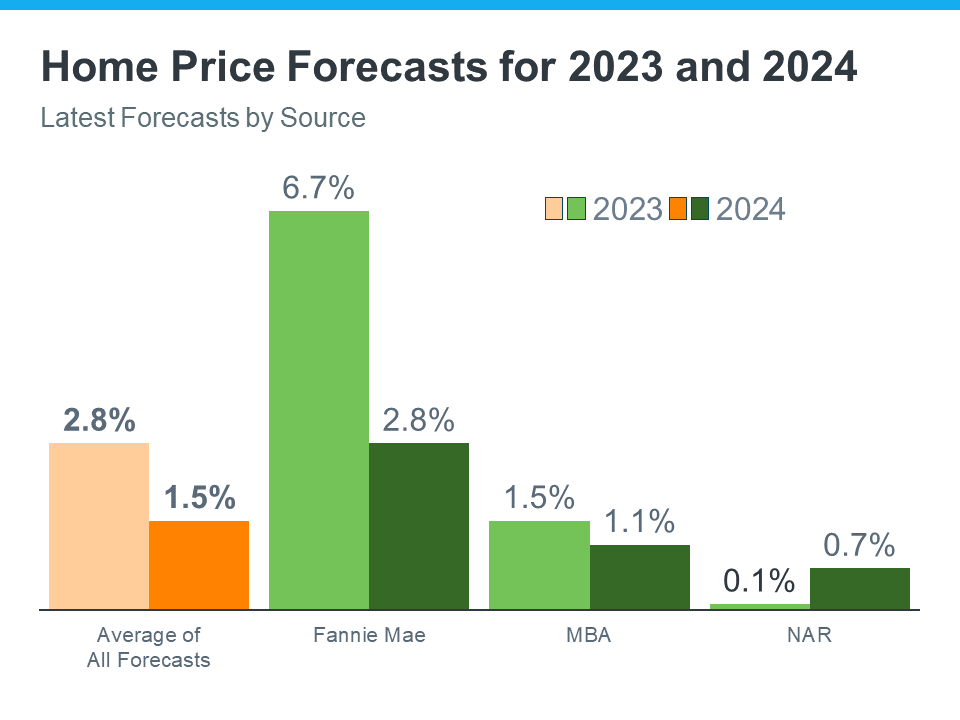
As you can see in the orange bars on the left, on average, experts forecast prices will end this year up about 2.8% overall, and increase by another 1.5% by the end of 2024. That’s big news, considering so many people thought prices would crash this year. The truth is, prices didn’t come tumbling way down in 2023, and that’s because there just weren’t enough homes for sale compared to the number of people who wanted or needed to buy them, and that inventory crunch is still very real. This is the general rule of supply and demand, and it continues to put upward pressure on prices as we move into the new year.
Looking forward, experts project home prices will continue to rise next year, but not quite as much as they did this year. Even though the expected rise in 2024 isn’t as big as in 2023, it’s important to understand home price appreciation is cumulative. In simpler terms, this means if the experts are right, according to the national average, after your home’s value goes up by 2.8% this year, it should go up by another 1.5% next year. That ongoing price growth is a big part of why owning a home can be a smart decision in the long run.
Projections Show Sales Should Increase Slightly Next Year
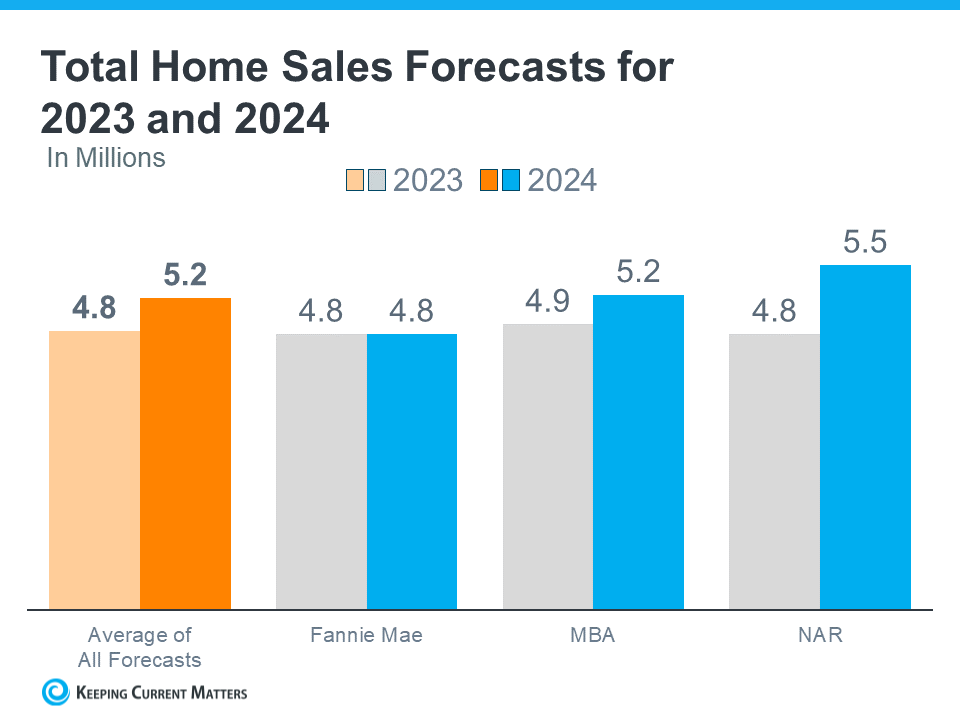
While 2023 hasn’t seen a lot of home sales relative to more normal years in the housing market, experts are forecasting a bit more activity next year. Here’s what those same three organizations project for the rest of this year, and in 2024 (see graph below):
While expectations are for just a slight uptick in total sales, improved activity next year is a good thing for the housing market, and for buyers and sellers like you. As people continue to move, that opens up options for hopeful buyers who are looking for a home.
So, what do these forecasts show? The housing market is expected to be more active in 2024. That may be in part because there will always be people who need to move. People will get new jobs, have children, get married or divorced – these and other major life changes lead people to move regardless of housing market conditions. That will remain true next year, and for years to come. And if mortgage rates come down, we’ll see even more activity in the housing market.
Bottom Line
If you’re thinking about buying or selling, it’s important to know what the experts are forecasting for the future of the housing market. When you’re in the know about what’s ahead, you can make the most informed decision possible. Connect with a local real estate agent to chat about the latest forecasts, and craft a plan for your next move.
Since today’s buyers are already dealing with higher rates and prices, you’ll want to assist them with another cost: a property’s homeowners association or HOA.
Membership in an HOA is mandatory for residents, with fees paid to maintain shared areas such as pools and landscaping. Although HOAs are a common part of condo and townhome lifestyles, a growing number of single-family homeowners are paying HOA dues.
HOA fees vary widely and may increase with little notice. There are also a few stories of fanatical HOA boards using fines or even foreclosure threats to enforce unpopular rules.
While buyer’s agents aren’t required to discuss a property’s HOA, it’s smart to offer guidance if needed. Here are some tips to share:
Ask for copies of all HOA covenants, bylaws, rules and regulations, and meeting minutes.
Research the HOA’s budget and reserve funds, and how often it has raised members’ fees.
Search the county website for HOA-filed liens, judgments or foreclosures.
Look at the HOA’s attorney fees. Excessive amounts suggest that the board is having legal issues, creating rules opposed by members, or both.
Attend an HOA meeting, if possible, to watch interactions between management and members.
In the face of high interest rates and rising home prices, the typical buyer’s income rose 22% to $107K. 1 out of 3 (32%) was a first-time buyer, and 89% used an RE agent.
What does the typical buyer look like in 2023? The typical seller?
The National Association of Realtors® (NAR) released its 2023 Profile of Home Buyers and Sellers this week. The annual survey tracked transactions between July 2022 and June 2023. It was first published in 1981 to give industry professionals a detailed insight into current home buying and selling behavior.
Median household income for 2023 homebuyers skyrocketed year-to-year, rising to $107,000 from $88,000 only one year earlier.
“Given the erosion of housing affordability due to higher home prices and mortgage rates, the household income for those who successfully purchased homes jumped by nearly $20,000 and topped six figures for only the second time in our records,” says Jessica Lautz, NAR deputy chief economist and vice president of research. “In a still-competitive housing market, more well-off homebuyers were able to have their bids accepted by offering larger down payments and even by paying cash.”
First-time buyers made inroads in the 2023 study. Those new to the market made up about one in three sales (32%) – up from 2022’s one in four ( 26%). However, that percentage is still notably lower than the 38% annual average in earlier years, starting in 1981.
The typical ages for first-time (35 years) and repeat (58 years) buyers declined slightly from the record highs of 36 years and 59 years, respectively, last year.
“First-time buyers tiptoed back into the market this year with less competition and fewer multiple-offer scenarios,” says Lautz. “While the share of first-time buyers is still near historic lows, it is higher than last year.”
Household composition also continues to shift: 70% of recent buyers did not have a child under the age of 18 in their home, the highest share recorded. By comparison, in 1985, just 42% of households did not have a child under the age of 18.
Three out of five (49%) of recent buyer couples were married couples – the lowest share since 2010 – while 9% were unmarried. More buyers were also going it alone: Single-female buyers (19%) and single male buyers (10%) both increased.
Based on type of property, 14% purchased a multi-generational home. The top reasons for doing so were to take care of aging parents, save money and accommodate children or relatives over the age of 18 who were moving back home.
Racial diversity: In terms of homebuyers’ race:
81% were white/Caucasian
7% were Hispanic/Latino
7% were Black/African American
6% were Asian/Pacific Islander
6% identified as some other race
One in 10 (10%) of buyers were born outside the U.S., up from 8% last year, and 6% spoke a primary language other than English, up from 5% last year.
“Homebuyers in the past year were more diverse, both racially and ethnically, with increases noted among minority buyers, buyers who were born outside of the U.S. and buyers whose primary language is not English,” says Lautz. “This shows encouraging signs that the homeownership rate may narrow in the future as more minority buyers enter the market.”
Distance from home: The median distance between the home recent buyers purchased and the home from which they moved was 20 miles, a decline from 50 miles 2022 and closer to the previous norm of 15 miles.
Similarly, while suburbs boomeranged back (47% in the 2023 report, up from 39% in the 2022 report), they remain under the levels seen in 2017 to 2021 when they made up more than half of all buyers. At the same time, small towns and rural areas remain more popular than they were over the same period.
Home financing: 80% of buyers financed their home purchase, up slightly from 78% last year but down from 87% two years ago.
The typical down payment for first-time buyers was 8% – the highest since 1997 when it was 9%. The typical down payment for repeat buyers was 19%, the highest since 2005 when it was 21%.
In securing down payments, first-time buyers increased their reliance on financial assets this year, using the sale of stocks or bonds (11%), 401k or pensions (9%), IRAs (2%) and/or the sale of cryptocurrency (2%).
Realtor services: Nine out of 10 buyers (89%) relied on the services of a real estate agent or broker – an increase from 86% last year. Of those, 90% would use their agent again or recommend their agent to others.
On the selling side, 89% of home sellers worked with a real estate agent to sell their home – an increase from 86% the year before.
“While the housing market had limited inventory and home prices were in flux, buyers and sellers both increased their use of real estate agents,” says Lautz. “Buyers wanted an expert to help them find the right home and conduct negotiations. Sellers relied on real estate agents and brokers to price their home competitively and market it to potential buyers.”
The typical home seller was 60 years old – unchanged from last year’s report. Sellers typically lived in their homes for 10 years before selling.
“Having a Realtor® help you navigate the home buying and selling process provides peace of mind, especially in a challenging market with high prices, elevated mortgage rates and limited inventory,” says NAR President Tracy Kasper. “Buyers and sellers can rely on Realtors’ expertise to shepherd them through one of life’s biggest and most important purchases.”
There is a lot of talk in the news about real estate agent commissions. They LOVE what they do and they do it because they LOVE helping people but there is almost always a huge misconception on what they do and how they get paid. It’s not a secret so here ya go…😊
The average FULL TIME REALTOR’s earnings last year was $31,900 @ 40+ hours a week. (Notice I wrote full time 40+ hours not 0-20 hours a week) which is well below the living wage. As a REALTOR they do not get paid a hourly wage or salary and they
only get paid if they sell a home and it closes. They can only get paid by broker to broker. As an agent you could work with someone days, weeks, months, or years with no guarantee of a sale ever.
Essentially they wake up each day unemployed going on Job Interviews and they deal with constant rejection. They dedicate time away from family, use our time, gas, pay for babysitters, miss dinner and weekends and rarely take vacations. They are on 24/7! You constantly need to be on, or you could miss an opportunity. Once they do close a home, half goes to the other persons agent from the remaining half. They have lots of upfront expenses that must be paid out before they even get paid:
Broker Splits and Fees
Office rent and utilities
MLS Fees
NAR Fees
Local Association Fees
E&O Business Insurance
Extended Auto Insurance
Self-Employment Tax
State Licensing Fees
Advertising Fees
Showing Service Fees
Website Fees
Assistant’s Salaries
Showing partners
Transaction coordinator
Yard Signs
Photographers
Videographers
Office Supplies
Business Cards
Property Flyers
Electronic Lockboxes
Continued RE Education
Legal Fees
Gas
Income taxes are not taken out so they have to put that aside around 25-30%.
Don’t forget health insurance if you don’t have a spouse who provides it.
As a listing agent they have lots of tasks far more than just selling a home.
1. Prepare Listing Presentation for Sellers
2. Research Sellers Property Tax Info
3. Research Comparable Sold Properties for Sellers
4. Determine Average Days on Market
5. Gather Info From Sellers About Their Home
6. Meet With Sellers at Their Home
7. Get To Know Their Home
8. Present Listing Presentation
9. Advise on Repairs and/or Upgrades
10. Provide Home Seller To-Do Checklist
11. Explain Current Market Conditions
12. Discuss Seller’s Goals
13. Share Your Value Proposition
14. Explain Benefits of Your Brokerage
15. Present Your Marketing Options
16. Explain Video Marketing Strategies
17. Demonstrate 3D Tour Marketing
18. Explain Buyer & Seller Agency Relationships
19. Describe the Buyer Pre-Screening Process
20. Create Internal File for Transaction
21. Get Listing Agreement & Disclosures Signed
22. Provide Sellers Disclosure Form to Sellers
23. Verify Interior Room Sizes
24. Obtain Current Mortgage Loan Info
25. Confirm Lot Size from County Tax Records
26. Investigate Any Unrecorded Property Easements
27. Establish Showing Instructions for Buyers
28. Agree on Showing Times with Sellers
29. Discuss Different Types of Buyer Financing
30. Explain Appraisal Process and Pitfalls
31. Verify Home Owners Association Fees
32. Obtain a Copy of HOA Bylaws
33. Gather Transferable Warranties
34. Determine Need for Lead-Based Paint Disclosure
35. Verify Security System Ownership
36. Discuss Video Recording Devices & Showings
37. Determine Property Inclusions & Exclusions
38. Agree on Repairs to Made Before Listing
39. Schedule Staging Consultation
40. Schedule House Cleaners
41. Install Electronic Lockbox & Yard Sign
42. Set-Up Photo/Video Shoot
43. Meet Photographer at Property
44. Prepare Home For Photographer
45. Schedule Drone & 3D Tour Shoot
46. Get Seller’s Approval of All Marketing Materials
47. Input Property Listing Into The MLS
48. Create Virtual Tour Page
49. Verify Listing Data on 3rd Party Websites
50. Have Listing Proofread
51. Create Property Flyer
52. Have Extra Keys Made for Lockbox
53. Set-Up Showing Services
54. Help Owners Coordinate Showings
55. Gather Feedback After Each Showing
56. Keep track of Showing Activity
57. Update MLS Listing as Needed
58. Schedule Weekly Update Calls with Seller
59. Prepare “Net Sheet” For All Offers
60. Present All Offers to Seller
61. Obtain Pre-Approval Letter from Buyer’s Agent
62. Examine & Verify Buyer’s Qualifications
63. Examine & Verify Buyer’s Lender
64. Negotiate All Offers
65. Once Under Contract, Send to Title Company
66. Check Buyer’s Agent Has Received Copies
67. Change Property Status in MLS
68. Deliver Copies of Contact/Addendum to Seller
69. Keep Track of Copies for Office File
70. Coordinate Inspections with Sellers
71. Explain Buyer’s Inspection Objections to Sellers
72. Determine Seller’s Inspection Resolution
73. Get All Repair Agreements in Writing
74. Refer Trustworthy Contractors to Sellers
75. Meet Appraiser at the Property
76. Negotiate Any Unsatisfactory Appraisals
77. Confirm Clear-to-Close
78. Coordinate Closing Times & Location
79. Verify Title Company Has All Docs
80. Remind Sellers to Transfer Utilities
81. Make Sure All Parties Are Notified of Closing Time
82. Resolve Any Title Issues Before Closing
83. Receive and Carefully Review Closing Docs
84. Review Closing Figures With Seller
85. Confirm Repairs Have Been Made
86. Resolve Any Last Minute Issues
87. Attend Seller’s Closing
88. Pick Up Sign & Lock Box
89. Change Status in MLS to “Sold.”
90. Close Out Seller’s File With Brokerage
As a buyers agent they also have many tasks.

1. Schedule Time To Meet Buyers
2. Prepare Buyers Guide & Presentation
3. Meet Buyers and Discuss Their Goals
4. Explain Buyer & Seller Agency Relationships
5. Discuss Different Types of Financing Options
6. Help Buyers Find a Mortgage Lender
7. Obtain Pre-Approval Letter from Their Lender
8. Explain What You Do For Buyers As A Realtor
9. Provide Overview of Current Market Conditions
10. Explain Your Company’s Value to Buyers
11. Discuss Earnest Money Deposits
12. Explain Home Inspection Process
13. Educate Buyers About Local Neighborhoods
14. Discuss Foreclosures & Short Sales
15. Gather Needs & Wants Of Their Next Home
16. Explain School Districts Effect on Home Values
17. Explain Recording Devices During Showings
18. Learn All Buyer Goals & Make A Plan
19. Create Internal File for Buyers Records
20. Send Buyers Homes Within Their Criteria
21. Start Showing Buyers Home That They Request
22. Schedule & Organize All Showings
23. Gather Showing Instructions for Each Listing
24. Send Showing Schedule to Buyers
25. Show Up Early and Prepare First Showing
26. Look For Possible Repair Issues While Showing
27. Gather Buyer Feedback After Each Showing
28. Update Buyers When New Homes Hit the Market
29. Share Knowledge & Insight About Homes
30. Guide Buyers Through Their Emotional Journey
31. Listen & Learn From Buyers At Each Showing
32. Keep Records of All Showings
33. Update Listing Agents with Buyer’s Feedback
34. Discuss Home Owner’s Associations
35. Estimate Expected Utility Usage Costs
36. Confirm Water Source and Status
37. Discuss Transferable Warranties
38. Explain Property Appraisal Process
39. Discuss Multiple Offer Situations
40. Create Practice Offer To Help Buyers Prepare
41. Provide Updated Housing Market Data to Buyers
42. Inform Buyers of Their Showing Activity Weekly
43. Update Buyers On Any Price Drops
44. Discuss MLS Data With Buyers At Showings
45. Find the Right Home for Buyers
46. Determine Property Inclusions & Exclusions
47. Prepare Sales Contract When Buyers are Ready
48. Educate Buyer’s On Sales Contract Options
49. Determine Need for Lead-Based Paint Disclosure
50. Explain Home Warranty Options
51. Update Buyer’s Pre-Approval Letter
52. Discuss Loan Objection Deadlines
53. Choose a Closing Date
54. Verify Listing Data Is Correct
55. Review Comps With Buyers To Determine Value
56. Prepare & Submit Buyer’s Offer to Listing Agent
57. Negotiate Buyers Offer With Listing Agent
58. Execute A Sales Contract & Disclosures
59. Once Under Contract, Send to Title Company
60. Coordinate Earnest Money Drop Off
61. Deliver Copies to Mortgage Lender
62. Obtain Copy of Sellers Disclosure for Buyers
63. Deliver Copies of Contract/Addendum to Buyers
64. Obtain A Copy of HOA Bylaws
65. Keep Track of Copies for Office File
66. Coordinate Inspections with Buyers
67. Meet Inspector At The Property
68. Review Home Inspection with Buyers
69. Negotiate Inspection Objections
70. Get All Agreed Upon Repair Items in Writing
71. Verify any Existing Lease Agreements
72. Check In With Lender To Verify Loan Status
73. Check on the Appraisal Date
74. Negotiate Any Unsatisfactory Appraisals
75. Coordinate Closing Times & Location
76. Make Sure All Documents Are Fully Signed
77. Verify Title Company Has Everything Needed
78. Remind Buyers to Schedule Utilities
79. Make Sure All Parties Are Notified of Closing Time
80. Solve Any Title Problems Before Closing
81. Receive and Review Closing Documents
82. Review Closing Figures With Buyers
83. Confirm Repairs Have Been Made By Sellers
84. Perform Final Walk-Through with Buyers
85. Resolve Any Last Minute Issues
86. Get CDA Signed By Brokerage
87. Attend Closing with Buyers
88. Provide Home Warranty Paperwork
89. Give Keys and Accessories to Buyers
90. Close Out Buyer’s File Brokerage
Whew…exhausting isn’t it!?! 🤯
✨You don’t need to buy or sell a home to support your agents real estate business – here are just a few simple ways to show your support! By sharing one of their listings, sending a friend or family member their way, letting them connect you with agents outside their area for a broker to broker referral, or leaving them a positive comment or review, this helps them feel seen and supported – (thanks to you)! ❤️✨

 Facebook
 X
X
 Pinterest
 Copy Link







 What does the typical buyer look like in 2023? The typical seller?